Hazards will not stop flashing
Posted to Technical Discussion Forum on 11/10/2019
6 Replies
This is not a request for help, but more a case study. Also,
first time posting, so hopefully I get this right.
The important part:
I manage a fleet that includes six 2010 Toyota Prius.
Surprisingly, this has happened to two of them within the
last 2 months. The problem is that the hazards would not
stop flashing and eventually the 12v battery would die. The
only way to stop them was to remove the 10A hazard fuse from
the under hood fuse box. Of course, you lose the turn
signals also, but at least the battery won't die. The
solution ends up being to replace the Skid Control Unit
(SKU), otherwise known as the ABS module, which is part of
the valve body.
I've searched for similar cases, and had discussion with two
dealer service writers. One other case can be found on an
internet forum, and another on this site. Neither dealers
had ever heard of such a problem - figures. That said, it
does not appear to be a common problem, or isolated to just
my fleet. Unfortunately, I've had to replace two SKU with no
idea why they failed, or if others will also.
Attached are both OE & Non-OE diagrams (AllData) for the SKU
with the hazard circuit highlighted. Also attached are some
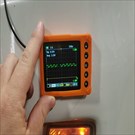
image files from the UScope - I just started using it, so
not sure how helpful they are.
The story time part:
Prius #1:
Driver reports hazards do not turn, occasionally flash very
rapidly, and sometimes faster at higher road speeds. Of
course I chalk this up as impossible; the driver must be
confused. When we got the car, the driver had removed the
hazard fuse. Upon replacing the fuse the hazards flash very
rapidly in pulses for a few seconds, then continue to flash
as normal. Turning the hazard switch on/off has no affect.
Key on/off no change. Did not test drive. No DTCs other than
battery voltage low.
A quick check with a DVOM showed the circuit was not shorted
to ground. This made for what seemed like a quick and easy
diagnosis of a malfunctioning hazard flasher. Part ordered,
dash removed to access the flasher, flasher replaced,
problem remains, mechanic spun.
I'll pause here to note that the hazard flasher module is
ground switched on pin 8 yellow of L55. It is under the dash
at the left front. It is an 8 pin component mounted to the
right side of a white junction assembly.
So, I consulted AllData, and after way too much effort, I
found that the hazard flasher input circuit is connected,
for no known good reason, to the SKU (connector A58, pin 10
sky blue). It is also wired into the BCU (connector L7, pin
3 yellow) as part of the keyless entry answer-back function.
All these connect internally at junction box 3 on pins
14,38,63, and 4. This is not shown entirely on either OE or
non-OE diagrams for the hazard warning lamps, SKU, or BCM:
- The hazard switch is shown on the ABS diagrams;
- The flasher is shown on the wireless door lock/antitheft
alarm diagrams;
- Neither ABS or BCM modules/connections are shown on the
hazard lamp diagram;
- Junction box 3 is shown on all diagrams though;
- The J/B 3 inner circuit diagram shows the connection of
pins 14-38-63-4, but without labels or other means of
identifying circuits or components.
This is not the exact order in which testing was performed:
•Service literature lists 10 Kohm or higher to ground
as the spec for this circuit with the hazard switch off.
•Testing the hazard input circuit with components
connected results in a reading that varies between 10 and 14
Kohms to ground. Hazards flash continuously.
•Testing the circuit with the ABS module disconnected
results in a steady reading of approximately 34 Kohms to
ground. Hazards do not flash.
•Testing the circuit after reconnecting the ABS module
results in a reading that varies between 1 and 6 Kohms for 1
to 2 minutes, then 6 to 14 Kohms for several more minutes
before eventually remaining steady at 10 -- 14 Kohms to
ground. Hazards flash/flutter very rapidly for shorts bursts
before flashing continuously at a normal speed. Suspect this
may be comms...
•Testing the circuit with all components disconnected
(flasher, ABS, and BCM) results in no continuity to ground.
•Testing with only the ABS connected results in 6 Mohm
& .45 volts to ground. Hazards do not flash
•Voltage on the circuit with the ABS disconnected is
.5 to 160 mV to ground.
•No scope was available at this time.
•Since it appears the hazard input circuit is being
grounded we back probe the circuit with a test light
connected to B+. This results in the hazards turning off and
the test light not lighting. It appears the circuit is
commanded/grounded on, but will not carry current for the
test light (as it does if the hazard switch is turned on).
• Also worth noting is that attempting to check
resistance of the circuit with a DVOM will cause the
flashers to operate/flutter very quickly. This will occur
with or without the other components connected. This is
likely due to the small voltage applied to the circuit from
the DVOM interacting with the flasher internal circuitry.
At this point, with no idea why the SKU is wired to the
flasher, we disconnected the flasher from the SKU.
Subsequent test driving though resulted in intermittent
invalid data from the R/R WSS. At this point we caved and
replaced the SKU, which solved all the problems. Used an
Autel MS906TS to do the activation/reset and bleed.
Prius #2, about 6 weeks after #1
Driver calls and says the battery is dead. Had a tow company
jump the car and the driver calls and says the ABS warning
lamp came on and the hazards started flashing briefly, but
did stop. He calls the next day; the battery is dead again.
We have the car towed to Toyota (it's over an hour away from
our shop).
Toyota calls and says it needs a battery and a hazard
flasher module, also to clean the HV fan. I eventually
convinced the service writer to tell the tech to check the
SKU. They call back and say it is the SKU. I won't identify
the dealer or what they quoted, but it was excessive, so we
let them warranty the battery and went to get the car.
Once in our shop we confirm the hazards flash key on, key
off, switch on/off, etc.; they don't stop without removing
the fuse or unplugging the SKU. Before replacing the SKU I
hook the new Uscope to the hazard circuit at the SKU to see
what it looks like - not obvious to me what it means (images
and video somewhere below).
RR the SKU and problem solved. Check the HV fan - spotless
(dealers, right?)
Best guess is some part of the SKU is shorted and somehow
interacting with the circuitry in the hazard module causing
the module to activate and flash the lamps.
Needless to say, a learning experience...
If anyone can explain why the SKU is wired to the hazard
circuit, I'd love to know. Any other comments or advice that
may help in the future is also appreciated.
Thanks for reading and I hope this helps others, or at least
entertains.
CK
[2010 Toyota Prius, ABS/Inputs/Outputs Document]
[2010 Toyota Prius, Video]
[Hazards Flashing, Malfunctioning SKU]
Chris Krause
Manager/Shop Foreman
Pizzo & Associates Ltd
Leland, Illinois, USA
Files Referenced:



 6 Replies Received
 6 Replies Received
 Vehicle Data
 Video
Video